
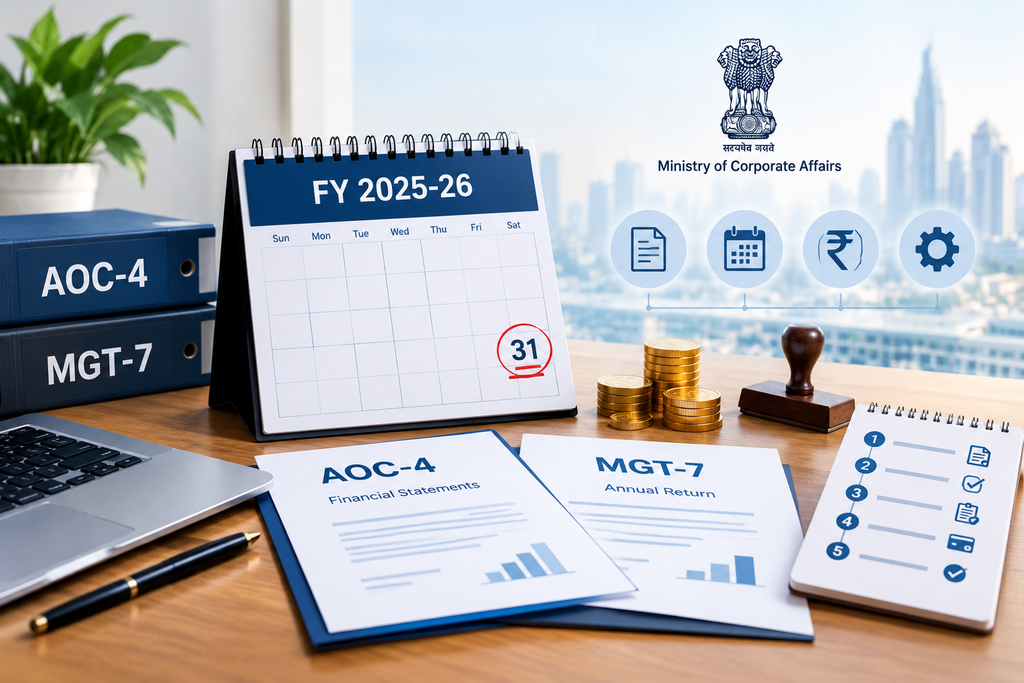
Picture a founder in Kochi who closed the books in May, held the shareholders’ meeting in late September and then assumed the hard part was over. Three weeks later, a reminder from the accountant lands: the company still owes two filings to the Registrar of Companies, and the ROC annual filing due date FY 2025-26 is only days away.
This situation is very common. The ROC annual filing due date FY 2025-26 does not follow the calendar year or the financial year. It follows the date of your own general meeting. For a company that met on 30 September 2026, the financial statements are due around 30 October and the annual return around 29 November.
Below, you will see how to work out your exact dates, which forms apply to your company, what delay costs and how to file online without avoidable rejections.
Your Deadline Depends on Your AGM, Not on March
Most filing mistakes begin with one wrong assumption: that the due date is fixed for everyone. It is not. The law sets a chain of dates, and each one is counted from the meeting.
- Meeting date: the AGM due date FY 2025-26 is within six months of 31 March 2026, so 30 September 2026 at the latest.
- Financial statements: filed within 30 days of the meeting.
- Annual return: filed within 60 days of the meeting.
A quick way to use this: write down the day your shareholders actually met, then add 30 and 60 days.
| If your meeting was on | AOC-4 deadline | MGT-7 deadline |
|---|---|---|
| 10 September 2026 | 10 October 2026 | 9 November 2026 |
| 22 September 2026 | 22 October 2026 | 21 November 2026 |
| 30 September 2026 | 30 October 2026 | 29 November 2026 |
An early meeting means an early deadline. Third-party calendars sometimes differ by a day, so confirm against the MCA portal and any circular issued after mid-October.
What if the meeting never took place?
The obligation does not disappear. The days are then counted from the last date on which the meeting should have been held. For this year that leads back to the same October and November dates, unless the Registrar approved extra time.
Which Forms Does Your Company Need?
These filings arise from Section 137 of the Companies Act, 2013 for accounts and Section 92 for the annual return. The right form depends on the type and size of your company.
| Company category | Accounts | Annual return |
|---|---|---|
| Standard private or public company | AOC-4 | MGT-7 |
| Small company | AOC-4 | MGT-7A |
| One Person Company | AOC-4 | MGT-7A |
| Companies needing XBRL or consolidation | AOC-4 XBRL or AOC-4 CFS | MGT-7 |
MGT-7 versus MGT-7A
MGT-7A is a lighter version for OPCs and small companies. Everyone else uses the full MGT-7. Submitting the wrong version is a known reason for portal rejection, so confirm your category first.
When is the AOC-4 XBRL filing requirement triggered?
The AOC-4 XBRL filing requirement covers certain larger and listed entities, while AOC-4 CFS is for consolidated accounts. If your company sits near the threshold, ask your CA before building the file.
The special case of One Person Companies
An OPC has no shareholder meeting, so its dates work differently. The accounts are due within 180 days of year end, which for FY 2025-26 meant 27 September 2026. The annual return runs from the date a meeting would have been due and lands in late November. Verify the exact day on the portal.
What Delay Really Costs
Late filing hurts in layers. First comes a per-day additional fee on each form. It is often quoted at Rs 100 a day, but check the current MCA schedule before relying on that number, since it can change.
Second come the penalties in the Act itself. Defaulting under Sections 92 and 137 can expose both the company and its officers. Because AOC-4 and MGT-7 are separate filings, a delay can create two defaults at once, which means a penalty for late AOC-4 filing and a penalty for late MGT-7 filing may stack.
Third come the practical consequences:
- Directors can face disqualification if accounts or returns stay unfiled across consecutive years.
- Lenders, investors and tender authorities often review MCA records, so an open default can slow a loan or deal.
- Cleaning up several years together is far slower than filing each year on time.
Here is a simple comparison. Company A keeps its audited accounts ready and files 30 days late. Company B has not finished its audit and files 30 days late. Both pay the same daily fee, but Company B still has to complete the accounts, so it loses weeks on top of the fee.
Paperwork to Gather Before You Log In
Having everything in one folder saves hours.
- Audited FY 2025-26 financial statements with the auditor’s signed report
- Board’s report and the AGM notice
- Details of directors, auditors and key managerial persons
- Updated shareholding pattern and statutory registers
- Evidence of the meeting and its date
- Valid digital signature certificates for the director and the filing professional
- A practising company secretary’s certificate where required, typically for larger or listed companies
Two cross-checks matter. The figures in AOC-4 must match the signed accounts. The details in MGT-7 must match your registers and what the MCA already shows for your company.
How to File AOC-4 and MGT-7 Online
This is the ROC annual return filing step by step sequence for the MCA portal.
- Complete the audit and have the report signed before the meeting.
- Hold the AGM and record the date.
- Calculate both deadlines by adding 30 and 60 days.
- Pick the correct versions: AOC-4 or its XBRL form, and MGT-7 or MGT-7A.
- Prepare attachments in the formats the portal accepts.
- Complete each form and run the built-in checks.
- Apply digital signatures from the required signatories.
- Pay the fee and submit, then save the SRN.
- Monitor the status and answer any resubmission request quickly.
Portal screens and rules change from time to time, so check the current MCA guidance before you submit.
A Broader Compliance Checklist for Private Companies
Annual compliance covers more than two forms. Use this wider ROC compliance checklist for private limited company to avoid gaps.
- AGM by 30 September 2026
- AOC-4 within 30 days of the meeting
- MGT-7 or MGT-7A within 60 days
- ADT-1 for the auditor’s appointment, within 15 days of the meeting
- MSME-1 half-yearly return where payments to small suppliers are pending (the April to September return is due 31 October 2026)
- DPT-3 return of deposits, if applicable
- DIR-3 KYC: reported to be triennial from FY 2025-26, so check each director’s cycle
Handle them as one closing exercise. A single missed item is easier to catch on a list.
Inactive Companies Still Have to File
A business with no revenue is still a registered company. It must file the accounts and annual return each year, even if the numbers are nil or tiny.
One more point: “inactive” in everyday speech is not the same as formally dormant status under the Act, which requires a separate application. Founders who confuse the two often stop filing and end up paying daily fees for years.
Errors That Trigger Rejections
- Counting from 31 March instead of the meeting date
- Using MGT-7 where MGT-7A applies, or the reverse
- Accounts in the form that differ from the signed statements
- Old director or shareholder data in the annual return
- Expired digital signatures or the wrong signatory
- Leaving the upload to the last evening, when the portal is slow
ROC Support for Kochi and Kerala Companies
Companies in Kerala usually file with the Registrar of Companies, Ernakulam. The rules are national, but local help is valuable when signatures and verification are time-sensitive.
Accruon Global Consultants supports ROC return filing through its compliances and certification services. Filing is easier when the numbers are clean, which is where our bookkeeping and accounting team helps all year. Signed financials are the base for AOC-4, and our audit and assurance team provides them.
New entrepreneurs can start with company formation in Kochi, and growing businesses can add a virtual CFO to manage the compliance calendar. More practical guides are on our blog, and the Accruon Global Consultants lists every service.
Final Thought
The mechanics of ROC annual filing are simple. The risk lies in timing. Your own meeting date sets the deadline, your company type sets the form and every day of delay adds cost.
The best move is a short one: find your meeting date, add 30 and 60 days and collect your documents this week. If 30 October is already close, file first and tidy the folder afterwards.
Want your AOC-4 and MGT-7 handled before the deadline? Contact and get your annual ROC filing done on time.
One Response