
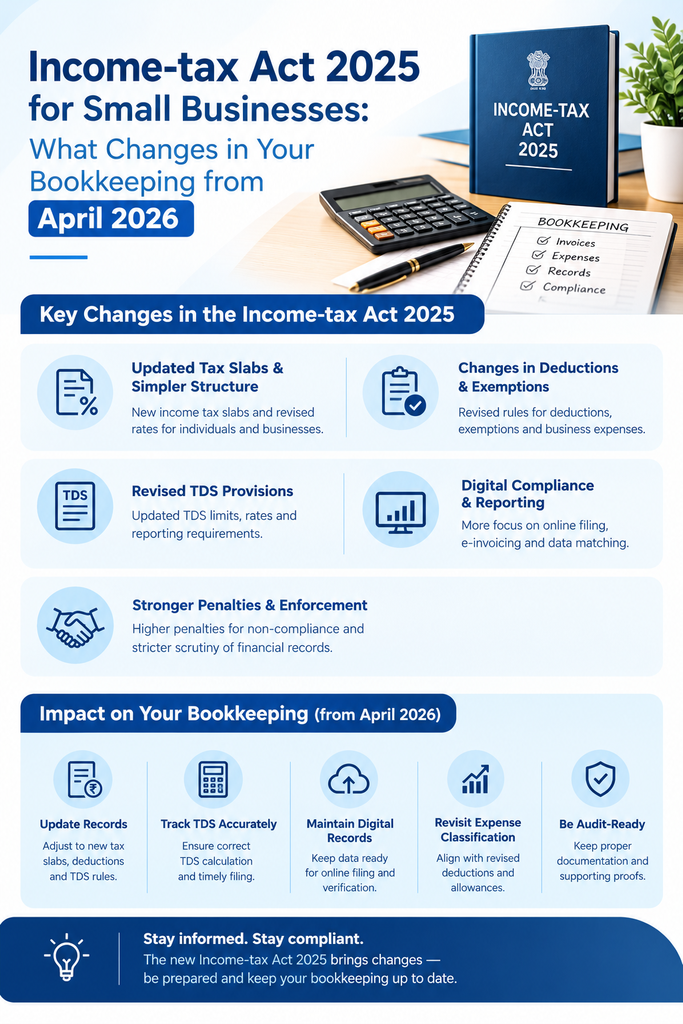
Most small business owners heard one headline: “India has a new income tax law.” Fewer asked the practical question. What do I do differently in my books, starting now?
The Income-tax Act 2025 for small businesses has been in force since 1 April 2026. It applies from Tax Year 2026–27. Many tax rules are carried over, but the section numbers, terms and record-keeping duties are not the same as before. A few of them hit your day-to-day bookkeeping directly.
This guide covers the Income-tax Act 2025 changes from April 2026 that matter to small firms, in plain language. It also gives you a checklist to act on.
What Does the Income-tax Act 2025 Mean for Small Businesses?
The Act replaces the Income-tax Act, 1961 with a rewritten, renumbered law. The aim is simpler language and structure, not a new tax philosophy.
For a small business, three points matter most:
- Your thresholds mostly stay the same. The turnover limits that decide whether you keep books or get audited have largely carried over.
- Your section references change. Your CA, your software and your notices will now quote new section numbers.
- Your record-keeping rules get stricter in two places. These are electronic backups and how long you keep records.
Think of it as the same road with new signboards and two new speed cameras.
Income-tax Act 2025 vs Income-tax Act 1961: The Changes That Matter
The official portal confirms that the Tax Year now matches the financial year, 1 April to 31 March. You do not need to change your accounting period.
| Topic | Income-tax Act, 1961 | Income-tax Act, 2025 |
|---|---|---|
| Time concept | Previous year and assessment year | Tax year (Tax Year 2026–27 covers income from 1 April 2026) |
| Books of account | Section 44AA | Section 62 |
| Presumptive taxation | Sections 44AD, 44ADA, 44AE | Section 58 (consolidated) |
| Tax audit | Section 44AB | Section 63 |
| Detailed record rules | Rule 6F | Rule 46, Income-tax Rules, 2026 |
Use this Income-tax Act 2025 section mapping old to new table when you read old notes, templates or software labels. Anything still saying “44AA” or “44AD” needs a mental translation.
Tax Year vs Previous Year and Assessment Year
The tax year vs previous year and assessment year change removes a long-standing confusion. Income earned in FY 2026–27 is simply “Tax Year 2026–27”. There is no separate assessment year to track.
Books for FY 2025–26 still follow the old law. Your first return under the new Act will be for Tax Year 2026–27. For one transition period, you will work with both laws side by side.
Income-tax Act 2025 Books of Account Rules: Who Must Keep Books?
The Income-tax Act 2025 books of account rules sit in Section 62, with details in Rule 46. The thresholds reported in current guidance are unchanged from the old regime:
- Individuals and HUFs in business: income above ₹2.5 lakh or turnover above ₹25 lakh in any of the 3 preceding years.
- Other persons (firms, LLPs, companies): income above ₹1.2 lakh or turnover above ₹10 lakh.
- Specified professionals (legal, medical, engineering, architecture, accountancy and similar): gross receipts above ₹1.5 lakh in each of the 3 preceding years.
If you are below these limits, books are not mandatory. You still need bank statements, bills and a simple income register to support your return, a loan application or a notice reply.
The Two Rule 46 Changes Small Businesses Must Act On
These are the points that most affect your Income-tax Act 2025 bookkeeping requirements.
- Daily India backup for electronic books. Rule 46(8) requires electronic books to stay accessible in India at all times. The backup must be kept on servers physically located in India and updated daily. If your accounting software is hosted overseas, you need a separate India-based backup arrangement. Tally’s guidance on the rule says you do not have to migrate everything to Indian servers.
- Seven-tax-year retention. Rule 46(9) requires books and documents to be kept for seven tax years from the end of the relevant tax year. The older rule was shorter. Keep GST records for the period GST law requires as well, and follow whichever is longer.
Tax auditors are also expected to report on compliance with the backup rule, including where the backup server is located. A spreadsheet on one laptop is now a real compliance risk, not just a convenience risk.
Income-tax Act 2025 Presumptive Taxation for Small Businesses
Presumptive taxation continues, now consolidated under Section 58. The core idea is unchanged. Eligible taxpayers declare a fixed percentage of turnover or receipts as income and skip detailed profit computation.
Commonly reported parameters:
- Businesses: deemed income of 8% of turnover, or 6% for digital receipts, with a turnover limit of ₹2 crore, extended to ₹3 crore if cash receipts and payments are each below 5%.
- Professionals: 50% of gross receipts, with a limit of ₹50 lakh, extended to ₹75 lakh under the cash condition.
Two cautions for your books:
- Presumptive does not mean no records. If you declare less than the deemed income and your total income exceeds the basic exemption limit, you must keep books and get a tax audit.
- You cannot claim a genuine loss under presumptive taxation without proper books. Banks also ask for profit and loss statements when you apply for a loan.
Some commentators warn that the new presumptive rules remove adjustments small businesses used before. Compare your real margin with the deemed rate before you opt in, and decide with your CA, not by habit.
Income-tax Act 2025 Tax Audit Limit
The Income-tax Act 2025 tax audit limit is now under Section 63, and audit continues in the prescribed cases. The commonly cited limits are:
- Businesses: turnover above ₹1 crore, or above ₹10 crore if cash transactions stay within 5%.
- Professionals: gross receipts above ₹50 lakh.
The audit report for Tax Year 2026–27 is filed in the new Form 26. Reports indicate that Form 26 asks auditors to confirm compliance with the Rule 46(8) backup rule. Your bookkeeping system is therefore now part of your audit evidence. If you are near a limit, plan early with your audit and assurance team.
Income-tax Act 2025 TDS and TCS Changes
TDS provisions have been consolidated and renumbered along with the rest of the Act. For most small businesses, the practical effect is on the labels and references in your books, not on how you deduct tax.
What to do:
- Update TDS ledger names and challan mapping to the new section references.
- Keep deduction, deposit and return records together by tax year.
- Ask your software vendor whether TDS masters have been updated.
Rates and thresholds can change through Finance Acts. Verify the current rate for each payment type before you finalise a year-end.
GST Reconciliation and Digital Records for Small Businesses
Your income tax books and GST filings tell the same story from two angles. When they disagree, notices follow.
Build these habits for Income-tax Act 2025 GST reconciliation for small businesses:
- Reconcile sales in your books with GSTR-1 and GSTR-3B every month.
- Match purchase entries with GSTR-2B before you book input credit.
- Use turnover figures net of GST when you test income tax thresholds.
- Explain every year-end difference between GST turnover and books turnover in a short note.
On digital records and e-invoicing, the Income-tax Act 2025 does not create a separate e-invoice mandate. GST e-invoicing already applies to larger businesses, so check the current threshold for your turnover. What the new Act adds is the India-backup rule for any electronic books you keep. Invoices issued from a billing system, scanned bills and a documented backup routine cover both laws.
Income-tax Act 2025 Penalties and Compliance Deadlines
Current commentary reports a penalty of ₹25,000 for failing to maintain books as prescribed, including the electronic backup requirement. It also reports that a missing or late tax audit carries a separate penalty. Confirm the exact amounts against the Act before quoting them to a client.
The bigger risk is practical. Weak records can lead to rejected electronic books and best-judgment assessments. Treat deadlines as a calendar:
- Monthly: close books, reconcile GST, check backups.
- Quarterly: TDS returns and advance tax review.
- Annually: tax audit if applicable, ITR filing, retention review.
Income-tax Act 2025 Compliance Checklist for MSMEs
Use this Income-tax Act 2025 compliance checklist for MSMEs to check your readiness.
- Confirm whether you must keep books, using the 3-year income, turnover or receipts tests.
- Decide on the cash or mercantile (accrual) method and apply it consistently.
- Update section references in templates, ledgers and software.
- Confirm where your accounting data and backups are hosted.
- Set up a daily backup on India-based servers and test a restore.
- Keep bills and vouchers as prescribed, and photograph them the day they arrive.
- Extend retention to seven tax years, and longer where GST requires.
- Review whether presumptive taxation really suits your margins.
- Check your turnover against the tax audit limit before year-end.
- Reconcile GST and books every month.
How to Prepare Your Books for the Income-tax Act 2025
Here is how to prepare your books for the Income-tax Act 2025 in four steps.
- Assess. Review your current records against Section 62 and Rule 46. Note where your software stores data. A fresh look from a bookkeeping and accounting team often finds gaps within a day.
- Fix the foundation. Separate personal and business transactions, build a monthly closing routine, and index bills against ledger entries.
- Align tax positions. Decide on presumptive or regular taxation with your taxation advisor, and test your turnover against the audit limits.
- Document compliance. Keep a short record of your backup arrangement, retention policy and reconciliation notes. This helps your auditor, and it helps if you ever receive a notice. If you also need regulatory filings and certificates, our compliances and certification service covers them.
Founders without an in-house finance lead can hand ownership to a virtual CFO, who sets the process once and reviews it every month.
Common Mistakes to Avoid
- Assuming nothing changed because the thresholds are the same.
- Using overseas-only cloud backups with no India copy.
- Throwing away records after six years.
- Opting for presumptive tax automatically without comparing real margins.
- Skipping small cash vouchers, which weakens your books in a scrutiny.
- Treating GST and income tax as separate worlds and never reconciling them.
Final Thought
The Income-tax Act 2025 for small businesses is more of a renumbering than a revolution. The real changes sit in your daily habits: where your data is backed up, how long you keep records, and how cleanly your books match your GST filings. Fix those now, while FY 2026–27 is still in progress, and your first return under the new law will be much easier.
Not sure whether your books meet the new rules? Speak to the chartered accountants at Accruon Global Consultants for a practical bookkeeping and compliance review. Contact our team to get started.
One Response